Training the chokes, locks, sweeps and throws of jiu-jitsu is an inherently dangerous activity, and for every dangerous activity there’s always a delicate balancing of risk and reward. You need to learn when to keep on pushing, and when to back off.
Never go 100% in training. And even in competition, you should always leave a little in reserve.
Sometimes it helps to have examples from other areas, which is why I want to quote from my book Perseverance, Life and Death in the Subarctic. about when it’s appropriate to really push yourself (hint: it’s NOT every time you step on the mats!).
Here’s an small section of my Arctic memoir where I’m discussing risk vs reward in adventure travel, but these ideas are actually quite relevant to jiu-jitsu training as well…
I recalled a conversation with a helicopter pilot years ago as he dropped me off on a survey project. I had asked him what the colors on his oil pressure gauge meant.
He pointed to the green area on the dial and said, “This zone is for my clients.”
Then he pointed to the yellow, “This zone is for if I get into trouble.”
Finally pointing at the red, he said, “And this is for the wife and kids.”
His job didn’t pay him enough to operate in the red zone, and he always wanted to leave a little in reserve just in case things went wrong. Given the extreme consequences of crashing a helicopter, he didn’t want to push the edge of the envelope daily.
Staying out of the red zone also applies to canoeing. When I was eighteen I befriended Gino Bergeron, an outdoorsman based in Quebec City who would go on long solo canoe and ski expeditions after every breakup in his tumultuous love life.
Our meeting was inspiring because it opened my eyes to the possibility that real people could do things like this on their own. If he could do it, then I could do it, too.
Gino gave me some of the best advice I ever received for solo traveling…
“You can go out into the bush by yourself, you can run whitewater by yourself, you can do hard things by yourself. But when you’re by yourself, the trick is always to stay a full level below what you know you can do. That way, you leave something in reserve » Continue Reading.
The post Balancing Risk and Reward in Training appeared first on Grapplearts.
2025-07-31 04:59:59
On today’s episode of The Strenuous Life Podcast, I’m joined by wrestler, jiu-jitsuka, and author Chris Jessulat (https://www.thewrongsideof35.com/) to discuss the best practices for staying relevant on the mats as you enter your fourth decade and beyond…
00:00 Training as an Older Grappler 02:48 The Transition from Competitive to Recreational Training 05:46 Physical Changes and Changing to a Mobility Focus 08:34 Quantifying Progress in Jiu-Jitsu 11:47 Breaking Through Training Plateaus 14:23 Comfort in Unfamiliar Positions 17:11 Training Strategies for Older Grapplers 29:35 Creating Positive Training Environments 31:12 The Impact of Focussing on Recovery and Positive Lifestyle Choices 33:41 Proactive Injury Management and Recovery Strategies 37:44 Navigating Injury Diagnosis and Treatment 40:51 Adapting Techniques and Mindset in Trainng 44:22 Reflections on Writing and Sharing Martial Arts Experiences 48:26 Lessons Learned from Martial Arts Training 51:20 The Importance of Community in Martial Arts
You can check this Episode 426 of The Strenuous Life Podcast anywhere you get your podcasts, including
Apple Podcasts Spotify Overcast Player FM Etc.
Or you can listen to it on the embedded player below…
Check out Chris’s great book on his site thewrongsideof35.com and/or follow him on instagram at @thewrongsideof35.
Cheers! Stephan Kesting
Related Resources BJJ For Old F***s, the 2-for-1 Deal!
The two BJJ for Old F***s volumes are two Grapplearts bestsellers featuring BJJ black belt instructors Rob Biernacki and Stephan Kesting.
These instructionals are your guide to surviving and thriving in BJJ after age 40. Every technique is chosen to work to be as low risk and high reward as possible because we know that if you get injured then you can’t train.
You’ll get our very best shortcuts gleaned from 55 years of jiu-jitsu training (and 70 years of martial arts training) by the two authors combined.
Click here to find out more about our best-selling program for older grapplers.
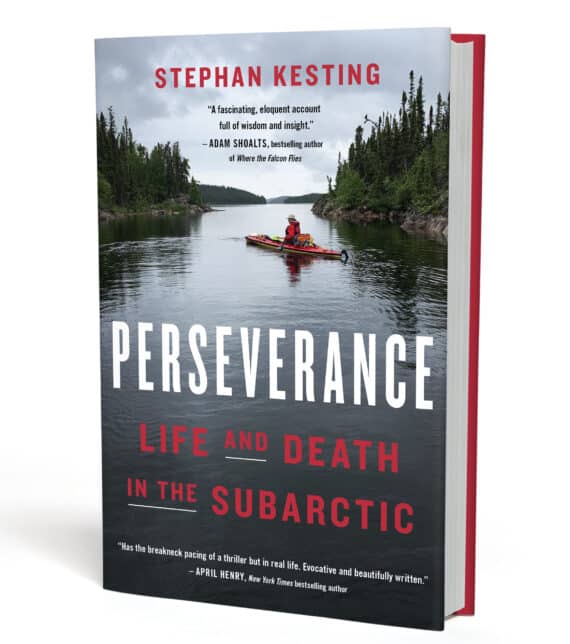
Perseverance, Life and Death in the Subarctic, The Book by Stephan Kesting
Perseverance, Life and Death in the Subarctic is my best-selling book covering the most difficult adventure in my life and the mindset hacks I used to develop grit, perseverance, and a never-quit attitude. It’s set in the deep wilderness but has many lessons directly relevant to anyone pursuing difficult enterprises, including BJJ.
Click here to check the book on Amazon.
The post BJJ After Age 35 appeared first on Grapplearts.
 » Continue Reading.
2025-06-24 16:36:10
On the most difficult adventure of my life I learned a lot about dealing with stress and adrenaline. That trip was deep in the wilderness, but it turns out that many of these lessons apply directly to many aspects of life, including jiu-jitsu.
That’s why I thought I’d share one of the more important sections of my book, Perseverance, Life and Death in the Subarctic that addresses this topic with you today…
Being able to do something in a tranquil environment is very different from being able to perform that same skill in a stressful situation. And the more stress you’re under, the greater the risk you’ll choke and forget everything you’ve ever learned.
We might live in big cities, drive cars, and have digital arguments with virtual friends, but we essentially have the same brains as our stone age ancestors who painted caves in Southeast Asia 40,000 years ago. Our neurology and physiology are primed to help us with stressful gross motor activities like chasing woolly mammoths and fleeing saber-toothed tigers.
The fight-or-flight reflex is always lurking just below the surface. When things get sufficiently stressful, our hormonal system dumps enormous amounts of adrenaline into our bloodstream, and — BOOM — suddenly we’re ready for action.
That adrenaline serves a purpose: it elevates your heart rate, makes you much stronger, more pain tolerant, and able to ignore injury. If you ever have to lift a car off a child, you don’t want to be calm. Instead, you want to be mad, scared, enraged—whatever it takes to get into that adrenaline-soaked state of high arousal to lift the damn car with your bare hands.
But that superhuman strength comes at a cost; as adrenaline floods your system, you lose a significant amount of fine motor control and higher brain function.
Essentially you’ll take whatever IQ you started with and cut it in half.
If Thrag the caveman was about to get trampled by an angry mastodon, he didn’t need to dial 911, stay calm, or talk about the mastodon’s feelings. He just needed to run faster, jump farther, and climb higher.
He needed gross motor solutions to gross motor problems. Thrag probably spent more time in dangerous situations than we do today in our pampered, cosseted, cubicled lives. So, ironically, he had more experience dealing with (and staying intelligent during) those highly adrenalized moments.
We rarely need to » Continue Reading.
The post How to Deal with Adrenaline in Stressful Situations appeared first on Grapplearts.
2025-06-05 04:55:02
When I was coming up in jiu-jitsu, there was a guy in class who only went for kneebars.
He was only a whitebelt but in this one move he was a purple belt. In the closed guard he went for kneebars… In someone’s guard, he went for a kneebar… if he was in the turtle position, or on top, or in a scramble: kneebar, kneebar, kneebar.
The problem was, he soon became predictable. All you had to do was defend that one move and his entire game would fall apart.
Now, I’m all in favour of focusing on certain positions for an extended period, such as weeks or even months if necessary. The difference is that the goal here is improvement, NOT just going back to the same well again and again.
Even if Mister Kneebar wanted to build his entire game around the kneebar, he should still have been working on other skills to complement it.
For example, getting good at guard passing or a second submission to set up his main attack (some ‘jabs’ to set up his cross).
We all know someone like that. Someone who had an early success with one technique – a collar choke… the guillotine… one certain guard pass… – and never moved on from there. Years later, he’s still doing the same thing to white belts, but everyone else has figured out his game.
However, achieving a blue belt level of success with one tactic and then failing to move forward is a sign of laziness and stagnation.
I’ve never understood why people spending hundreds of hours on an activity (jiu-jitsu, golf, canoeing, tango dancing, or whatever) don’t make a more concerted effort to get better. I mean, they’re already out there sweating, bleeding and spending the money on the sport, so why don’t they use their brains and the resources available to them to improve?
Don’t just always get on the mat and grind it out, fun as that might be.
Instead, do just a little research, approach the sport just a bit scientifically, and be just a bit more focused in your training so you’re training to improve and NOT just doing the same thing over and over.
Sometimes this’ll result in you developing black belt levels of skill in areas you were already pretty good at, and sometimes you’ll surprise yourself with a whole new game.
The writer Marshall » Continue Reading.
The post Don’t Be a One Trick Jiu-Jitsu Pony appeared first on Grapplearts.
2025-05-21 05:27:22
It’s just a matter of time but if you’re training, then you’ll eventually run into an untrained guy who wants to test his skills by brawling on the mats.
These are usually the “In a fight, I just see red, bro!” guys.
They’re never very skilled, but the problem is that even the reddest of the just-seeing-red bros present some danger.
That’s because they’ll go zero to one hundred in the first moments of the match. Deep down, they know they have no gas tank, and so they gamble everything on winning in the first few seconds.
If this were a street fight, they’d have one flurry of wild, desperate, untrained punches.
There’s no skill or strategy here, but if one of those haymakers catches you on the chin, it could still knock you out.
In a grappling context, they’ll have a rudimentary plan, which is usually to grab onto something, then squeeze and twist as hard as possible.
If they catch a headlock, they’ll hang on for dear life, which means that escaping will be a slow, painful process for you. Alternately, they’ll grab a foot and then try to twist it off with all their strength.
These are low-percentage attacks, but because they’re so unorthodox and uncontrolled, they can still be dangerous. There’s zero control and zero looking out for your joint health.
The first rule of going against one of these just-see-red bros is to avoid injury.
Therefore get your grips, control their ability to move, and don’t let them get the grip they want.
The second rule is to tire them out.
Once you have a good grip and/or established a dominant position then you should hang on for the ride as they thrash around for 30 seconds and completely gas out.
When they’re completely exhausted, systematically submit them as many times as possible for the rest of the round.
Good luck with your training!
Stephan Kesting
P.S. If you’re looking for gripfighting techniques and strategies then check out The Gripfighting and Kuzushi Formula with Rob Biernacki, available here on this site.
P.P.S. And if you’re looking for ways to defend yourself against much larger man-monsters on the mat then check out How to Defeat the Bigger Stronger Opponent. This series » Continue Reading.
The post Dealing With The “I Just See Red Bro” Guy! appeared first on Grapplearts.
